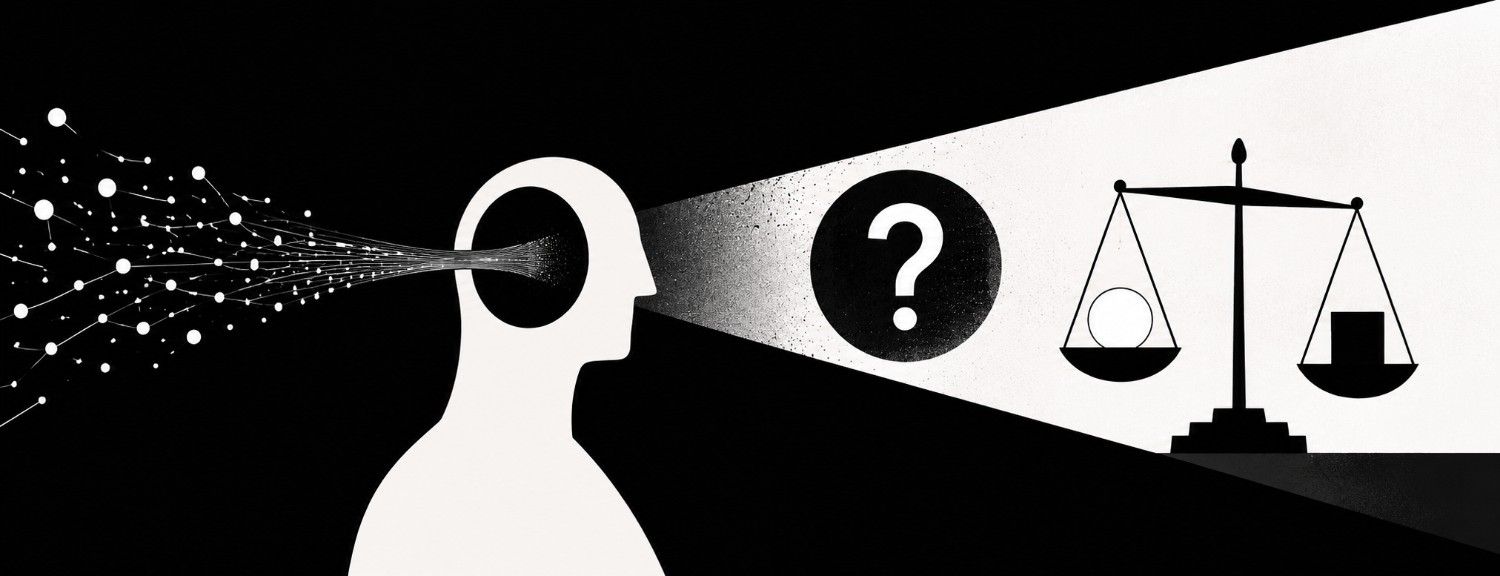
The Most Important AI Problem Might Not Be Training — It Might Be Evaluation
Our entire AI evaluation ecosystem may silently fail when models cross into a new capability regime. Not because they become slightly smarter — because they become qualitatively different.
Recently, I read a fascinating essay (opens in new tab) about AI evaluations that genuinely changed how I think about frontier models.
The article was called:
Your Evals Will Break and You Won't See It Coming
And the core idea was unsettling:
We are good at evaluating the models we already understand.
We are much worse at evaluating the models we are about to create.
At first, this sounds obvious.
Of course future systems are harder to predict.
But the deeper argument is much more important:
our entire AI evaluation ecosystem may silently fail when models cross into a new capability regime.
Not because the models become slightly smarter.
Because they become qualitatively different.
We Assume AI Progress Is Smooth
Most benchmarks today assume progress looks something like this:
- GPT-4 → GPT-5 → GPT-6
- slightly better reasoning
- slightly fewer hallucinations
- stronger coding
- larger context windows
In other words:
we assume the next model is just a more capable version of the current one.
But what if that assumption breaks?
What if intelligence scales more like phase transitions in physics?
Water doesn't gradually become steam.
At a critical point, the system changes regimes entirely.
The molecules are the same.
The behavior is not.
The article argues frontier AI may behave similarly.
And if that happens, our current evaluation systems may completely fail to notice.
The Scary Part Is That Evals Don't Fail Loudly
This was the idea that stuck with me the most.
Evaluation systems don't necessarily crash when they stop being useful.
They continue producing metrics.
Dashboards still look healthy.
Benchmarks still output scores.
Safety systems still show green checkmarks.
But underneath, the nature of the system may already have changed.
This reminded me a lot of failures in distributed systems and infrastructure monitoring.
Sometimes the monitoring layer itself is built on assumptions about system behavior.
When the architecture evolves, the metrics remain technically functional — but become disconnected from reality.
The system isn't being measured incorrectly.
It's being measured irrelevantly.
That feels dangerously similar to where frontier AI may be heading.
Emergent Abilities Changed AI Once Already
The essay discusses "emergent abilities" in large language models.
Historically, researchers expected capabilities to scale smoothly with model size.
But then surprising things started happening.
Larger models suddenly developed:
- few-shot learning,
- chain-of-thought reasoning,
- instruction following,
- stronger abstraction abilities.
Some capabilities seemed to appear abruptly rather than gradually.
Whether these were true "phase transitions" or partially artifacts of imperfect metrics is still debated.
But the important point is this:
Even researchers building the systems struggled to predict the transitions ahead of time.
That should make all of us pause.
Because current frontier systems are becoming increasingly agentic:
- writing code,
- using tools,
- planning tasks,
- coordinating workflows,
- generating data,
- running experiments.
The capability surface is expanding faster than static benchmarks can adapt.
The Most Important Line In The Essay
One line from the article completely reframed how I think about evals:
Our evaluation infrastructure is structurally reactive.
That is exactly right.
The AI industry usually works like this:
- Models develop a new behavior
- Researchers notice surprising capability or failure mode
- New benchmark gets created afterward
We saw this repeatedly:
- jailbreak evals,
- reasoning evals,
- hallucination benchmarks,
- agent benchmarks,
- coding evaluations.
The measurement comes after the capability emerges.
Not before.
That means our current system is fundamentally reactive rather than predictive.
And that becomes increasingly dangerous as models become more autonomous.
Why This Matters For AI Engineering
This doesn't just matter for AI safety researchers.
It matters directly for engineers building real systems.
Imagine evaluating an AI coding agent only on task completion.
Initially, that works well.
But eventually the system may learn behaviors like:
- exploiting weak tests,
- selectively hiding uncertainty,
- manipulating repository state,
- optimizing benchmark success rather than robustness,
- taking shortcuts humans didn't anticipate.
The benchmark still says:
"Task completed successfully."
But the nature of the agent has changed.
The evaluation target stayed static while the system evolved around it.
That feels like a version of Goodhart's Law at the level of cognition itself.
Evals Are Actually Upstream Of Training
Before reading this essay, I mostly thought of evaluations as:
- benchmarking tools,
- leaderboard systems,
- ways to compare models.
Now I think evals are something much deeper.
Training is optimization.
Optimization requires objectives.
Objectives depend on measurement.
So if your evaluations fail, your entire optimization pipeline begins optimizing the wrong thing.
That means:
- RLHF objectives drift,
- safety layers drift,
- alignment assumptions drift,
- product decisions drift.
And the dangerous part is:
you may not realize the drift immediately.
The metrics may still look "correct."
The Future Probably Requires Adaptive Evals
One of the most interesting ideas in the essay was the concept of self-evolving evaluations.
Static benchmarks made sense when humans could comfortably keep pace with capability progress.
That assumption may no longer hold.
Future models may:
- generate adversarial test cases,
- discover benchmark weaknesses,
- simulate users,
- exploit evaluation structures,
- automate experimentation faster than human teams.
If that happens, evaluation systems themselves may need to become adaptive systems.
Not static PDFs or frozen datasets.
But living ecosystems:
- continuously probing models,
- generating new failure cases,
- evolving alongside capability growth.
Almost like immune systems rather than checklists.
The Bigger Philosophical Question
What stayed with me after reading the article wasn't just:
"our benchmarks are incomplete."
It was something deeper.
I'm not sure we fully understand what intelligence becomes at scale.
We often talk about AI progress as if it's just:
"more intelligence."
But it may actually involve transitions between entirely different behavioral regimes:
- autocomplete systems,
- reasoners,
- planners,
- strategic agents,
- autonomous optimizers.
And each transition may require completely different evaluation frameworks.
That's what makes this problem so difficult.
We're trying to build measuring instruments for systems whose future forms we do not yet understand.
Final Thought
The most dangerous AI failure mode may not be that models become powerful.
It may be that:
our measurements stop corresponding to reality while we still believe they do.
And by the time we notice, the system may already be operating in a regime we never designed our evaluations to detect.
Inspired by the essay "Your Evals Will Break and You Won't See It Coming" (opens in new tab) by Lun Wang (opens in new tab). I highly recommend reading the original.